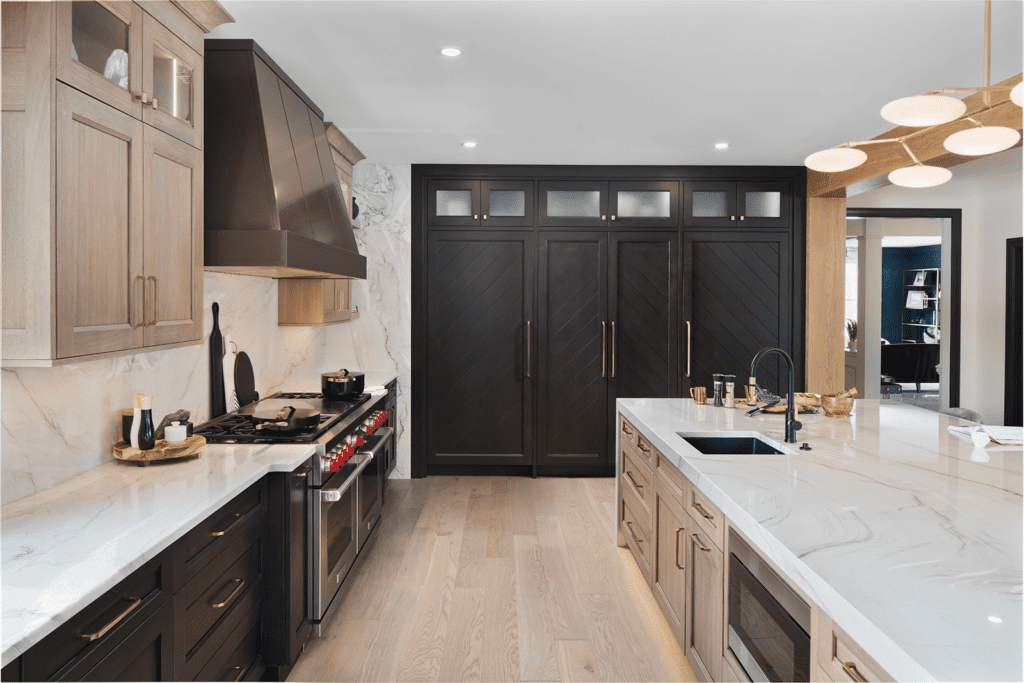
Appliances are essential to the way a kitchen functions, but they do not always need to become part of its visual focus. Refrigerators, dishwashers, microwaves, coffee makers, and countertop appliances can introduce different finishes, proportions, and visual breaks into an otherwise cohesive room.
A thoughtful custom kitchen cabinet design can reduce those interruptions by integrating appliances directly into the cabinetry or concealing them when they are not in use. The result is a kitchen that feels calmer, more intentional, and often more furniture-like, without sacrificing the appliances homeowners rely on every day.
The key is planning cabinetry and appliances together rather than treating appliance placement as an afterthought.
How Do Panel-Ready Appliances Create a More Seamless Kitchen?
Panel-ready appliances are designed to accept cabinet fronts that coordinate with the surrounding cabinetry. Refrigerators and dishwashers are two of the most common examples.
Instead of a large stainless-steel refrigerator interrupting a wall of cabinetry, matching panels allow it to visually recede into the room. A dishwasher can similarly disappear beneath the countertop.
This approach creates longer, more continuous cabinetry lines and gives designers greater control over the overall composition of the kitchen. Our guide to blending appliances and cabinetry explores how appliance integration contributes to a unified design.
Reducing visible appliance surfaces does not mean eliminating contrast entirely. Rather, it allows homeowners to decide where contrast belongs instead of letting every appliance dictate the visual rhythm of the room.
What Kitchen Appliances Can Be Hidden?
Refrigerators and dishwashers may be the most obvious candidates, but custom cabinetry can minimize many other appliances as well.
Microwaves can be incorporated into cabinetry or positioned within an island rather than installed prominently above the range. Small appliances can be stored behind appliance-garage doors, while coffee makers and beverage equipment can become part of dedicated stations.
Depending on the homeowner’s routines, cabinetry might conceal:
- Coffee and espresso machines
- Toasters and blenders
- Mixers and food processors
- Microwave drawers
- Beverage refrigerators
- Charging stations and other countertop electronics
These solutions keep frequently used items accessible without requiring them to remain visible throughout the day.
As we discussed in our guide to unique custom cabinet features, the best storage solutions are often designed around the homeowner’s specific habits rather than a standard list of cabinet features.
How Do Appliance Garages and Pocket Doors Work?
An appliance garage creates a dedicated home for smaller appliances directly on or near the countertop. When closed, the cabinetry maintains a clean appearance. When open, everything needed for a particular task is immediately accessible.
Pocket doors can take this idea further. Instead of swinging outward into the workspace, doors retract into the cabinetry, allowing coffee stations, breakfast areas, or prep zones to remain completely open while in use.
For homeowners who want even greater separation between everyday prep and the main kitchen, a concealed pantry or scullery kitchen can move appliances and working areas behind an integrated doorway.
The goal is not simply to hide things. It is to make them accessible when needed and visually quiet when they are not.
Can Hidden Appliances Work With Different Kitchen Styles?
Integrated appliances are often associated with minimalist kitchens, but the concept can work across many design styles.
In contemporary kitchens, flat panels and minimal hardware can make appliances nearly disappear. In transitional spaces, paneled appliances can continue Shaker-style cabinetry across a wall without interruption. Traditional kitchens may use detailed panels, moldings, and furniture-inspired elements to make refrigeration feel more like architectural cabinetry.
That flexibility is one reason appliance integration works so well within custom kitchen cabinet design. The solution can be adapted to the architecture rather than forcing the kitchen toward one particular aesthetic.
A furniture-style kitchen island, for example, might conceal a beverage refrigerator behind a coordinated panel while still maintaining the appearance of a freestanding furniture piece.
Why Should Appliance Planning Happen Early?
Appliance integration works best when appliance specifications and cabinetry layouts are developed together.
Different models have specific requirements for ventilation, electrical connections, plumbing, clearances, door swings, and installation. Even small dimensional differences can affect surrounding cabinets.
Early planning also allows the designer to consider how appliance placement affects the larger kitchen workflow. A refrigerator may look perfectly integrated but still create frustration if its doors interfere with an island or if frequently used appliances are positioned far from the appropriate work zone.
This is where an experienced cabinet designer becomes especially valuable. Appliance specifications, cabinetry dimensions, storage needs, and traffic patterns can all be considered as parts of one design rather than separate decisions.
How Do You Balance Concealment With Everyday Function?
A clean appearance should never make a kitchen harder to use.
Hidden appliances still need appropriate ventilation and clearance. Doors must open comfortably. Frequently used equipment should remain convenient to access. Countertop appliances need adequate electrical service, and concealed stations may require additional lighting or heat considerations depending on their use.
These practical details are why BCCD’s design process starts with understanding how homeowners actually use their kitchens. A family that prepares coffee several times a day needs a different solution than someone who wants to conceal specialty appliances used only occasionally.
Good design finds the balance between what you want to see and what you need to reach.
Creating a Kitchen That Feels Intentional
The strongest custom kitchen cabinet design does not call attention to every functional component. Instead, cabinetry, appliances, storage, and architecture work together as one complete space.
Panel-ready refrigeration, concealed dishwashers, appliance garages, integrated coffee stations, and other unique custom cabinets can reduce visual clutter while making everyday routines easier. The result is not simply a kitchen with fewer visible appliances. It is a kitchen where every element feels like it belongs.
At Bucks County Cabinetry and Design, our team works with homeowners, designers, architects, and builders to coordinate cabinetry with the appliances and layout from the beginning of the project.
Explore our custom kitchen gallery for inspiration, or contact us to begin planning a kitchen where function feels seamlessly built into the design.